
Wireless Camera Systems for Couplings You Cannot Cable
Every fleet with trailers eventually faces the same problem: a cable that has to be plugged and unplugged hundreds of times a year, and fails. A wireless link removes the failure point entirely.
Wireless vehicle cameras are not a replacement for wires everywhere. They make sense in three specific cases: a trailer that physically disconnects from its tractor, a forklift or machine where routing a cable through the mast is impractical, and a temporary or seasonal installation where drilling holes is not acceptable.
The engineering questions that matter are transmission range, interference immunity and pairing behaviour. Our FWR range uses dedicated receivers rather than shared WiFi, transmits reliably beyond 100 metres in the open, and supports both manual and automatic pairing so a driver can swap trailers without a technician.
Wireless Systems — all 11 models
Every model in this range, with its product photograph, features, ordering notes and installation guidance.

FWR wireless audio and video transmission package (transmitting + receiving, no video cable required, 500m
Wireless audio and video transmitter + receiver package: camera end transmitter, cab end receiver, no need to pull long video cables
View details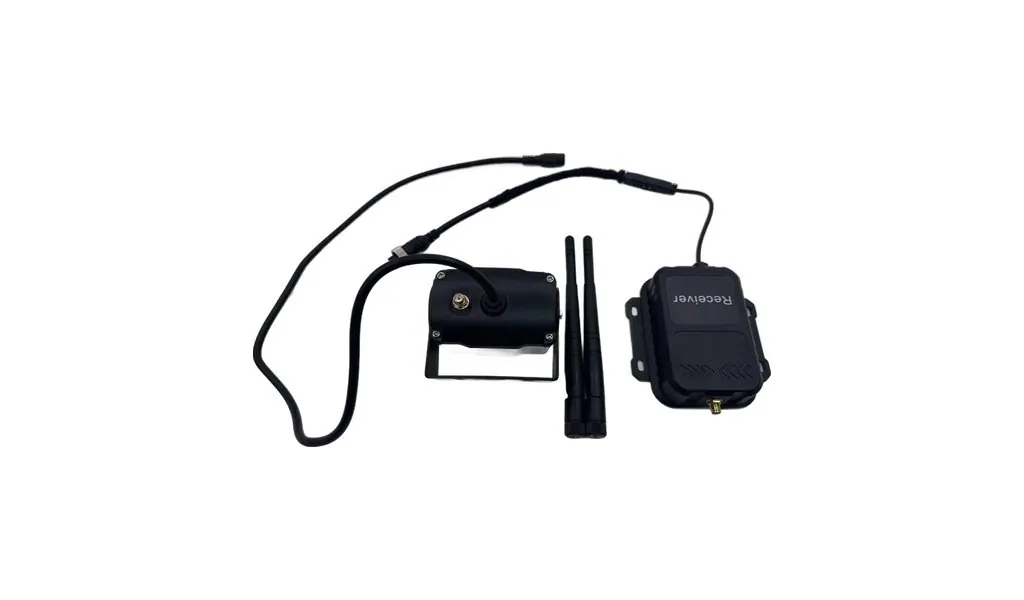
FWR-139 Wireless Camera + Receiver Kit (720P Starlight Night Vision / IP69 / 120m Transmission)
Wireless camera + receiver set, no video cable needed; Transmission distance 120 meters
View details
FWR-510 5-inch wireless license plate/bracket reversing set (wireless rear view, no wiring required)
5-inch wireless receiving monitor + wireless camera set: No need to pull video cables, fast loading
View details
Battery-3 power bank (20000mAh / 74Wh / TYPE-C charging / 5V + 12V dual output)
20000mAh / 74Wh large-capacity mobile power supply, specially designed to power vehicle monitoring equipment: rear view monitoring, …
View details
FWR-701F 7-inch forklift wireless camera set (magnetic installation / 120m transmission / IP69K)
Magnetic installation: The camera is directly attached to the forklift overhead guard/car body. No drilling or dismantling of the ve…
View details
FWR-1002-30 30x optical zoom wireless hook monitoring set (10.1-inch monitor + 30× zoom camera)
30x optical zoom + auto focus (screen display
View details
Battery-1 special battery for forklift camera (9600mAh / 12V / battery life about 15 hours / IP68)
9600mAh large capacity, continuous power supply for about 15 hours, you can work all day without charging midway
View details
FWR-701 7-inch digital wireless rear view + DVR recording system (1080P / multi-screen / supports BSD version)
7-inch digital wireless rearview system: wireless camera + wireless display, no video cable
View details
FWR-701B 7-inch wireless camera set with battery (no power connection needed, magnetic mount/preferred for temporary
The camera has a built-in battery, no need to draw power from the car body - most suitable for trailers, drop-offs, temporary instal…
View details
FWR-701FF 7-inch wireless forklift set (green laser positioning + infrared night vision 50m, private model)
Green one-character laser precise positioning: The laser hits the front of the fork. The operator can know where the fork is aimed b…
View details
FWR-701P new rear view wireless camera (private mold housing)
Private mold shell: The appearance is a customer-specific mold. The same model cannot be found on the market. It is suitable for pri…
View detailsWireless or wired?
Wireless costs more per channel than a cable and introduces a component that can lose signal. If the camera and monitor are on the same rigid vehicle, run a cable — it is cheaper, faster and more reliable. Choose wireless when one of these is true:
- The vehicle articulates. A semi-trailer coupling is a cable failure waiting to happen. Wireless removes the connector that breaks.
- The route is impractical. Forklift masts, crane booms and agricultural implements have no sensible cable path.
- The installation must be reversible. Rental fleets, lease vehicles and seasonal equipment should not be drilled.
Getting the range right
Our published ranges are barrier-free line-of-sight figures. In practice, range is reduced by metal bulkheads, by the trailer body itself, and by other radio traffic in the yard. A practical rule of thumb is to halve the quoted range and then check that the remaining figure comfortably covers the distance between the transmitter and the receiver on the actual vehicle geometry. On a standard semi-trailer the distance is rarely more than 15 metres, so even with heavy attenuation there is generous margin.
Frequently asked questions
Will the wireless signal interfere with other vehicles in the yard?
Each kit pairs with its own receiver and can be set to its own channel or pairing code, so neighbouring vehicles do not cross-talk. Automatic pairing makes swapping trailers straightforward, and manual pairing is available where fleets want a fixed, locked pairing.
How is the trailer camera powered?
From the trailer electrical system where one is available (the auxiliary circuit), or from a rechargeable battery pack where the trailer has no permanent power. The battery versions are designed for swap bodies and short-haul trailers that may sit unpowered for long periods.
Is a wireless kit as reliable as a cable?
For a fixed vehicle, no — a cable wins. For an articulated vehicle, a wireless link is generally more reliable in service than a cable that gets plugged and unplugged several times a day and eventually fails at the connector. That connector failure is the single most common trailer camera fault we see.
Browse the rest of the catalogue
Truck & Vehicle Cameras
Side, front, rear and interior cameras for trucks, buses, forklifts and specialist vehicles.
Vehicle Monitors
5 to 12.3 inch AHD monitors, single, split and quad view, mirror and waterproof types.
360° Panoramic & Safety Systems
Bird's-eye panoramic imaging with AI blind spot detection, radar and driver monitoring.
MDVR & Dashcams
Mobile DVRs and dashcams with GPS, 4G, WiFi and cloud alarm storage.
Car & Aftermarket Cameras
Compact cameras for cars and light vehicles in Korean, European and plate-mount bodies.
Thermal Imaging Cameras
Vanadium-oxide thermal cameras that detect people and vehicles in darkness, dust and smoke.
OEM Replacement Cameras
Plug-and-play replacement cameras for Ford, Mercedes, BMW, Honda, Kia, Hyundai and more.
Camera Interfaces & Decoders
Video interface and decoder modules for factory screens and OEM camera systems.
Need help choosing from the wireless systems range?
Tell us the vehicle, the application and the destination market. We will recommend a model and quote within 24 hours.