
08. When a Vehicle Camera Goes Purple: The Conditions That Cause It
Purple video is a conditional fault, not a random one. It appears when a colour camera sees more infrared than its filter is removing — because the filter is in the wrong position, because it is moving, or because the camera was built without one at all. That last case is the one we meet most often in the field, and it is a specification rather than a fault. The useful question is therefore not what the purple looks like, but when it appears — and that is the first question we ask whenever a customer sends us a purple clip.

Key takeaways
- Purple only happens on a colour camera with a moving IR-CUT filter, and only when infrared reaches the sensor it should have been blocked from.
- Most purple cameras in the field are 850 nm LED units with no IR-CUT fitted at all, because the housing has no room for the mechanism — a specification, not a fault.
- Purple in every light condition is a failed filter. Purple for half a second at a tunnel mouth is the mechanism working normally.
- The flash is a timing overlap: 200-500 ms of filter travel against 100-300 ms of colour calculation.
- Purple that lasts several seconds means the light is sitting on the switching threshold and the hysteresis is too narrow.
- Ask for a white-balance freeze during the transition and a wider brightness threshold before you ask for more resolution.
Two installers can report “the picture goes purple” and be describing two completely different faults: one a filter that has failed mechanically, the other a camera behaving exactly as a mechanical design behaves. The timing of the fault separates them. A purple image that is always there, in every light condition, is a failure. A purple flash at a tunnel mouth is a mechanism doing what a mechanism does, and the answer is a firmware setting rather than a replacement.
The three things that must be true before purple is possible
A CMOS colour sensor does not measure colour. Each pixel sits under a red, green or blue filter in a mosaic pattern, so it measures brightness through one of those three windows only. Colour is reconstructed afterwards by comparing neighbouring pixels — the process is literally called guessing, and it works because the three filters pass visible light in a predictable way.
Near-infrared breaks that predictability. It passes through the red, green and blue filters almost equally, so an infrared-rich scene drives all three channels towards the same high value at once, and the reconstruction has nothing valid to work from. Attempting to guess anyway produces the familiar magenta; refusing to guess produces a monochrome picture, which is exactly what the camera does at night when infrared illumination is deliberate.
Daylight contains a great deal of infrared, so three things have to be true at once for a purple picture to be possible in daylight:
- The camera is a colour camera. A monochrome camera shows a grey picture when infrared arrives, never a purple one.
- It has a mechanical IR-CUT filter with two positions — one that blocks infrared in daylight, one that takes the filter out of the path at night. A camera with a fixed infrared-blocking filter cannot produce this fault in daylight at all. A camera built with no filter is purple all day, in every condition, and that is a specification rather than a defect — which is common enough in practice to have its own section below.
- Infrared is reaching the sensor when it should not be — because the filter is in the wrong position, or because it is moving between the two.
Every condition below lives at the third point. They differ only in why the sensor is seeing infrared while the image processor is trying to work in colour, and they are separated mainly by when it happens.
What the filter assembly actually is
Strip away the part numbers and the filter is a simple object: a small carrier holding two pieces of glass, a coil or a small motor that moves the carrier between two stops, and a two-pin lead back to the camera board. One position puts the daylight plate in front of the sensor, the other puts the night plate there. Generic replacements are sold for CCTV cameras as a matter of course, which tells you how often this particular component is the one that fails.
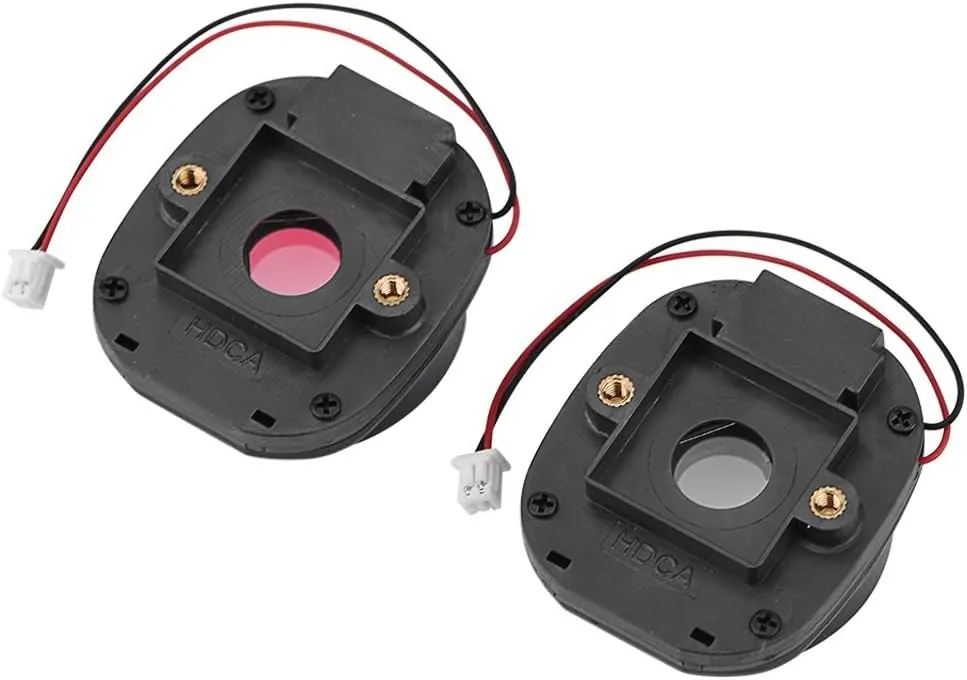
The two plates are not interchangeable and they are never stacked. The daylight plate is an infrared-cut filter: it passes visible light and blocks everything above roughly 650–700 nm. The night plate does the opposite — either it passes the whole spectrum, or it is a band-pass filter matched to the LED wavelength, so the sensor receives the illuminator’s light and little else. The industry name for the arrangement is True Day/Night: colour while the cut plate is in the path, monochrome infrared when it is out of it.
The daylight plate is made one of two ways, and the difference matters when you are choosing a camera. An absorptive plate — the blue glass in cheaper assemblies — absorbs the infrared. An interference, or dichroic, plate reflects it with a thin-film coating, cuts much more sharply, and is what a colour-critical camera uses. It has one drawback: its cut wavelength shifts with the angle at which light arrives, which is exactly why a plate specified for a 60° lens can leak infrared at the edges of a 150° one.
There is a second reason to cut the infrared beyond colour, and it is easily missed. A lens is focused for visible light, and near-infrared comes to a slightly different focus, so a picture carrying an infrared component is not only tinted but slightly soft as well. Cutting the infrared in daylight keeps the lens at the focus it was designed for; that is why an infrared-contaminated image tends to look wrong and fuzzy at the same time.
For a human viewer all of this is cosmetic. For a machine it is not. Exposure metering and automatic plate recognition both assume they are looking at visible light, and a camera whose daylight image carries an infrared component breaks that assumption — a blue plate read as violet is a failed read, not a tinted photograph.
The case we meet most often: 850 nm LEDs and no room for a filter
Ask which cameras in a mixed fleet turn purple and the answer is usually the same: the ones with infrared LEDs and no IR-CUT at all, because the housing has no space for the mechanism. Night vision needs infrared, and at 850 nm the LEDs are cheap, effective and almost invisible to the eye — but they only help if the sensor can see infrared at night, which is what the moving filter is for. Where there is no room for a carriage and its solenoid, some housings are built permanently open rather than made larger.
In that camera the daylight image is purple as soon as the scene carries enough infrared, and it makes no difference whether the LEDs are lit: the sun is the infrared source, not the illuminator. The brighter and clearer the day, the more infrared there is and the stronger the cast; overcast weather and indoor scenes are milder but still not correct. Nothing is broken and no firmware update will change it — the camera is doing what it was built to do.
There is a reason 850 nm behaves worse than the alternatives. Visible light ends around 780 nm, and 850 nm sits just beyond it, where silicon still responds strongly, so a good part of it passes the red and the blue filters in the Bayer pattern at the same time. That mixture is precisely what produces magenta. The cause is infrared arriving at the sensor rather than the 850 nm figure itself, so changing the LEDs does not remove it — see the question on 940 nm below.
The two plates inside a mechanical IR-CUT explain the other version of the fault. One plate cuts infrared and is used in daylight; the other passes the LED wavelength and is used at night. They are interchanged, never stacked, and a carrier fitted the wrong way round leaves the infrared-pass plate in the path during the day — the same picture as a filter that never returned, from a mechanism that clicks perfectly.
This is also the one case where a five-second test settles the argument, because a camera that was never fitted with a mechanism cannot click. Cover the lens and uncover it: a stuck filter will at least try to move, and a camera built without one is silent from the day it is unpacked. That is the difference between a warranty claim and a specification, and it is the test we ask for in our first reply rather than after a replacement has been shipped.
Condition 1 — the filter is in the wrong position and it stays there
The blocking filter is not in front of the sensor when it should be, so the camera sees infrared all day. The picture is permanently purple or desaturated, in every light condition, from the moment the camera is switched on. Common causes are a carriage that has jammed or lost power, a solenoid that will not release, a filter that has broken free of its carrier, or a camera built without one.
This is the condition that is genuinely a warranty case, and it is also the cheapest to check: cover the lens and uncover it. A working mechanism cycles audibly and changes state every time. If the mechanism moves but the colour never recovers, you are in condition 1. If it is silent and the camera has been purple since the day it was unpacked, the section above is the better explanation.
The same part can fail in the opposite direction. A filter that never leaves the path gives correct daytime colour and an almost black night picture even with the infrared LEDs lit, because the camera’s own illumination never reaches the sensor. It is the same moving part, and it is replaced the same way.
Condition 2 — the light is sitting on the switching threshold
This is the condition behind the purple flash that most customers describe as a fault, and it is worth understanding properly, because a camera can be electrically perfect and still do it.
When the light level falls past the switching point, the camera decides the scene has gone dark and issues the command to withdraw the filter. Two events then happen on completely different timescales, and they overlap badly:
- The filter is mechanical. A solenoid-and-carriage assembly takes roughly 200–500 ms to travel from one position to the other. That is not a manufacturable-part problem; it is what a moving part does.
- The colour calculation needs frames. The image processor averages 100–300 ms of video before it can compute a reliable colour temperature for the scene.
- The processor commits before the filter has settled. For those few hundred milliseconds the sensor is receiving a mixture of unfiltered infrared and light that is still changing. Whatever colour temperature the processor settles on during that window is wrong, and it then applies that correction to the following half second or more of video.
The result is a purple or magenta cast lasting up to about a second, every time the light crosses the threshold. In a vehicle that means tunnel and underpass mouths in both directions, covered car parks and freight yards, wash bays and workshops, tree-lined avenues, and dawn and dusk — which are a long, slow crossing of the same threshold rather than a single event.
The remedy is firmware rather than hardware: freeze the white balance at the moment the filter command is issued and resume it once the filter has settled, and widen the brightness hysteresis so the filter needs several seconds below the threshold before it moves at all. A camera with those two behaviours turns a purple second into a purple frame or two that no viewer notices.
Some low-cost designs deal with the problem by removing colour instead — dropping saturation to zero the moment the light falls below a threshold, which trades a purple flash for a grey picture. That is a legitimate engineering decision, and worth knowing about before you buy, because it also means the camera will not show you a signal lamp’s colour after dusk.
Condition 3 — the light keeps crossing the threshold
Around the switching point there is a band of light levels close enough to the threshold that small changes decide the filter position. Inside that band the camera is not switching once; it can be switching again and again.
Driving along a tree line, past regularly spaced lamp posts, or along a road with intermittent shade moves the light above and below the threshold every few seconds. Each crossing costs 200–500 ms of mechanical travel and then a further 100–300 ms before the colour calculation has a clean scene to work from. Add those together and the camera can spend most of that stretch of road applying a colour correction computed from a scene that no longer exists.
This is the condition that produces a purple cast lasting several seconds rather than a flash, and it is the one that most often becomes a complaint, because a driver on the same route every day sees it repeatedly in the same place.
Two settings decide how bad it is, and neither appears on a datasheet: how far below the threshold the light has to stay before the filter is allowed to move, and whether the white balance is frozen while the filter travels. A few tens of lux held for a few seconds is a reasonable starting point.
Condition 4 — the filter is there, but the infrared load beats it
Here the mechanism works, the filter is in position, and most of the scene is the correct colour. Then a black cotton shirt turns purple, or a blue number plate goes violet, in bright sun. The difference between those objects and everything else in the frame is how much infrared they reflect.
Black cotton absorbs visible light but reflects near-infrared strongly. If the blocking filter is not cutting deeply enough — cheap filter glass, or a filter specified for a narrower lens angle than the housing actually has — enough infrared gets through off a strong reflector to push the processor into magenta. Leather and many painted surfaces reflect far less, which is why the fault looks selective and is easy to dismiss as an oddity on one particular vehicle.
This is a material or specification problem, not a firmware one, and it becomes worse in bright summer sun and at altitude, where the infrared content of daylight is at its highest. The answer is to reject the sample rather than try to adjust it — we would rather swap out a sample at that point than spend a season tuning around filter glass that was never cutting deeply enough.
Condition 5 — purple that has nothing to do with infrared
A thin purple or blue fringe along a high-contrast edge — bright sky against a dark vehicle, a lit sign against shadow — is usually lens dispersion, not infrared contamination. Light of different wavelengths focuses at slightly different points, so hard edges pick up a colour fringe.
It is a property of the lens, it is cosmetic unless it is severe, and no filter or firmware setting will remove it. The distinction matters because the two faults get reported in the same words: infrared contamination tints whole areas and follows the light conditions, while dispersion draws a line along an edge in any light.
What it looks like in a recording
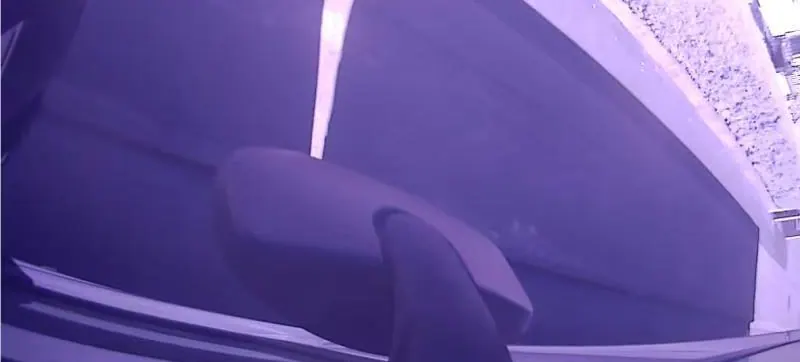
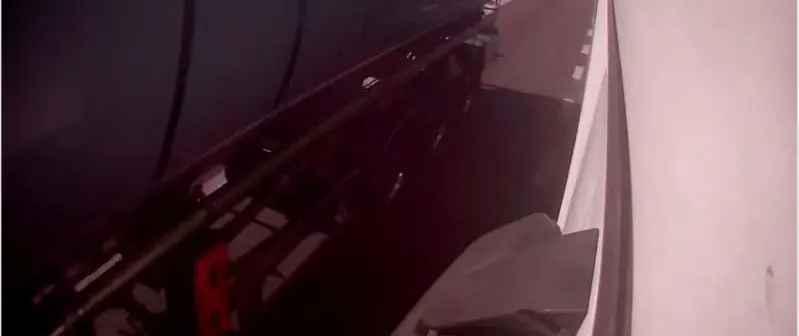
Both of the frames below are daylight recordings from the same family of equipment, and neither has been retouched beyond removing the device and GPS overlays. They are the reason this article spends its time on conditions rather than on colours: the same fault looks different from one camera and one light level to the next.
Which condition are you in?
| Condition | What you see | What it means, and what to do |
|---|---|---|
| 1 | Purple or desaturated all day, and the mechanism still tries to move when you cover the lens | The filter is stuck open — a carriage or solenoid failure. Cover the lens and listen: the carriage should cycle and the colour should come back. If it never recovers, replace the module |
| no filter | Purple or desaturated all day, from the first switch-on, with no click when you cover the lens | An 850 nm LED camera built without room for a filter. Physics, not a fault — the sun’s infrared reaches the sensor all day. If daylight colour is required, the camera is the wrong specification; if the design cannot take a filter, run it in monochrome |
| 1 (reversed) | Daytime colour is correct, but night vision is almost black even with the IR LEDs lit | The same filter, stuck in the daylight position this time. Check whether the mechanism moves at all, and replace the module if it does not |
| 2 | Purple flash of roughly half a second to a second, entering or leaving a tunnel or underpass | The light is crossing the switching threshold while the filter travels. Normal for a mechanical IR-CUT filter, and fixable in firmware: freeze the white balance during the transition and widen the brightness hysteresis |
| 3 | Purple cast lasting several seconds along a tree line or in intermittent shade | The light keeps crossing the threshold. The hysteresis is too narrow: ask for a longer dwell below the threshold before the filter is allowed to move |
| 4 | Black fabric, tyres and blue number plates turn magenta in bright sun; other colours are correct | The filter is not cutting deeply enough. A material quality problem, worse in summer and at altitude — reject the sample rather than adjust it |
| 5 | Thin purple or blue line along high-contrast edges only | Lens dispersion, not infrared. A lens property, cosmetic unless severe; reduce it by choosing a lens with better colour correction |
Reproducing each condition before you buy
Four of the five conditions can be reproduced deliberately on a first sample, in half a day. The one that needs a road is the one that most often becomes a complaint, so drive it. That sample test is the one we recommend running before a fleet order, not after the cameras have been fitted.
- Midday sun test (condition 4). In bright sunlight, point the camera at a black cotton shirt and a blue registration plate. A marginal filter shows the shirt as purple and pushes the plate towards violet. Both must stay correct.
- Tunnel test (condition 2). Drive into and out of an underpass at normal speed, then review the recording at normal speed and frame by frame. Count how many colour excursions last longer than a quarter of a second.
- Shade-line test (condition 3). Drive along a tree-lined road on a bright day and watch the colour over a full minute. This is the condition a bench test never reproduces, and the one that generates repeat complaints.
- Cover test (condition 1). Cover the lens with your hand and uncover it repeatedly. The mechanism should click audibly and change state every time.
- Cold start test. If the vehicle operates below freezing, leave a sample in a cold chamber or a freezer overnight and repeat the cover test. Solenoid IR-CUT mechanisms are the components most likely to stick at low temperature.
- Sun-angle test (conditions 2 and 4). In open ground at low sun angles, look for a wash of magenta across the frame. That only appears when the infrared load is at its highest.
- Filter question at quotation (the 850 nm case). Ask two things before a sample is ordered: which wavelength the LEDs are, and whether the camera has a moving IR-CUT. “850 nm, and no filter because the housing has no room” predicts a purple image in every sunny scene, and no amount of testing will change that answer.
Specifying it so the condition never becomes a complaint
- State the requirement as colour, not as a part. “No colour cast when driving through a tunnel at 60 km/h, and no infrared contamination on black fabric at midday” is a testable requirement. “Must have IR-CUT” is not.
- Ask how the firmware handles the transition. A white-balance freeze during filter travel and a wide brightness hysteresis are worth more in service than a higher resolution sensor, and neither appears on a specification sheet unless you ask for it.
- Ask about the filter, not just its presence. A filter designed for a 60° lens may not perform correctly in a 150° housing, because light arrives at the glass at a much steeper angle. Wide-angle cameras need filters specified for wide-angle use.
- Be explicit about night colour behaviour. If operators rely on seeing a blue signal lamp at dusk, a camera that drops to monochrome below a brightness threshold is unsuitable however good its daytime colour is.
- If the camera feeds automated plate recognition, remember that infrared contamination can defeat it entirely: a blue plate read as violet is failed by the recognition algorithm even though a human eye can still read it.
Colour faults are cheap to test for and expensive to discover in service, because by then the cameras are on vehicles in another country and the conversation is about replacements rather than specifications. Half a day spent reproducing the conditions above on a first sample is the cheapest insurance in this category.
Housings built for this duty use a pendulum IR-CUT mechanism and physically separate the LED board from the lens — the JPC-171 is our reference example. If you want the sensor side of the story first, read how to read a camera datasheet.
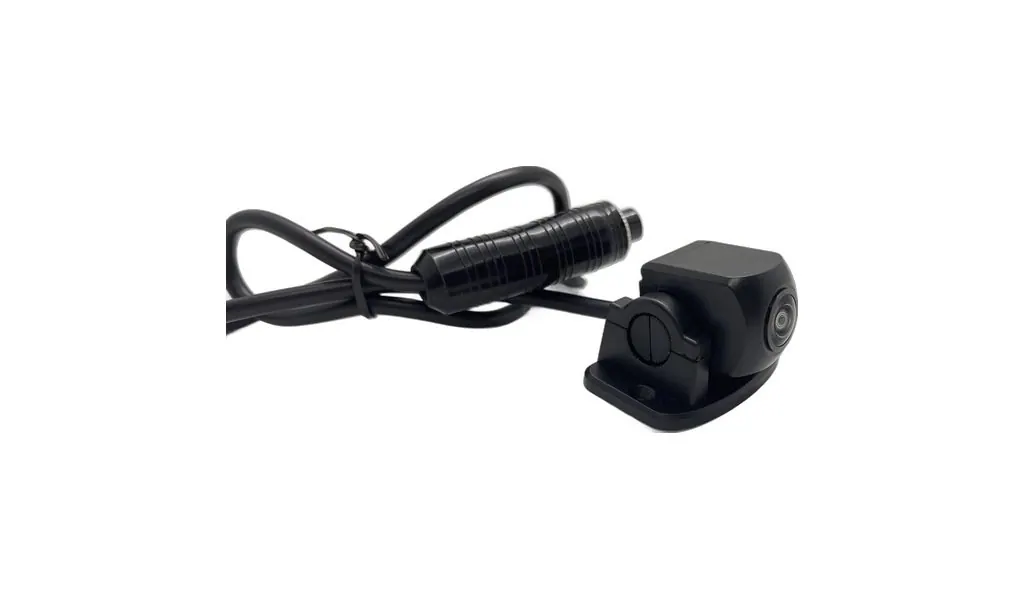
The same mechanism, working as designed at night, is in night vision explained; the housings we supply for this duty — including the model pictured at the top of this page — are in the truck camera range.
Frequently asked questions
Why does the camera only go purple at a tunnel entrance?
Because the light is crossing the switching threshold while the filter is still moving. The mechanism needs roughly 200–500 ms to travel, and the colour calculation needs another 100–300 ms of frames before it has a stable scene. During that overlap the processor settles on a colour temperature computed from a mixture of daylight and unfiltered infrared, and then applies it. It is normal behaviour for a mechanical IR-CUT design, and it can be reduced with firmware: freeze the white balance during the transition, and widen the brightness threshold so the filter does not chase every change in light.
Why do black clothes look purple when everything else in the picture is fine?
Black cotton reflects near-infrared strongly even though it absorbs visible light. If the image processor sees a strong infrared return where it expected black, it produces magenta — the visible sign of an infrared-blocking filter that is not cutting deeply enough. Leather and many painted surfaces reflect far less, which is why the fault looks selective rather than general. It is a filter quality problem rather than a firmware one, and it is worst in bright summer sun and at altitude.
The camera is black and white during the day. Is that a setting?
Almost always a stuck IR-CUT mechanism rather than a setting. If the filter cannot move back into position, the sensor keeps seeing infrared and most firmware drops colour altogether rather than showing a purple picture. Listen for the mechanism when you cover the lens; if it never actuates, the assembly has failed. A few low-cost designs also drop to monochrome deliberately below a brightness threshold, which is worth checking in the manual before condemning the filter.
Can a firmware change really stop the purple cast?
It can remove the flash, if the image processor supports it: freezing the white balance while the filter travels, and requiring the light to stay below the threshold for several seconds before switching at all. That covers conditions 2 and 3, which are the ones customers normally complain about. It cannot help with condition 1, where the filter is physically stuck, or condition 4, where the filter glass does not block deeply enough — those are hardware.
The IR LEDs are off in daylight, so why is the picture still purple?
Because in daylight the infrared comes from the sun, not from the camera’s LEDs. A sunny scene delivers far more infrared than the illuminator ever does, which is why an 850 nm camera with no IR-CUT is purple at midday with the LEDs switched off, and why the cast gets stronger as the sky clears. The LEDs matter at night, where they are the only infrared source.
Would 940 nm LEDs avoid the problem?
No. 940 nm is still infrared, and a sensor with no filter still sees it. The cast is usually milder — sunlight carries less energy at 940 nm and silicon responds to it less strongly — but the price is a darker, noisier night image with less reach. It also has to be matched: a 940 nm filter sitting behind 850 nm LEDs blocks almost all of the illumination the camera has.
Does a 150° camera need a different IR-CUT filter?
Yes. Light arriving at a steep angle passes through an interference filter at a different effective angle, which shifts the wavelengths it blocks. A filter specified for a narrow-angle lens can leak infrared at the edges of a wide-angle frame. Wide-angle housings need filters designed for wide-angle incidence.
Related articles
04 Camera Sensor Guide: 2053, 8536H, 307 — What the Chipset Numbers Mean
How to read a vehicle camera datasheet: sensor size, what chipset numbers such as 2053, 8536H and 307 actually mean, lens construction, WDR and IR-CUT filters.
06 Night Vision for Commercial Vehicles: How to Read Lux and IR Specifications
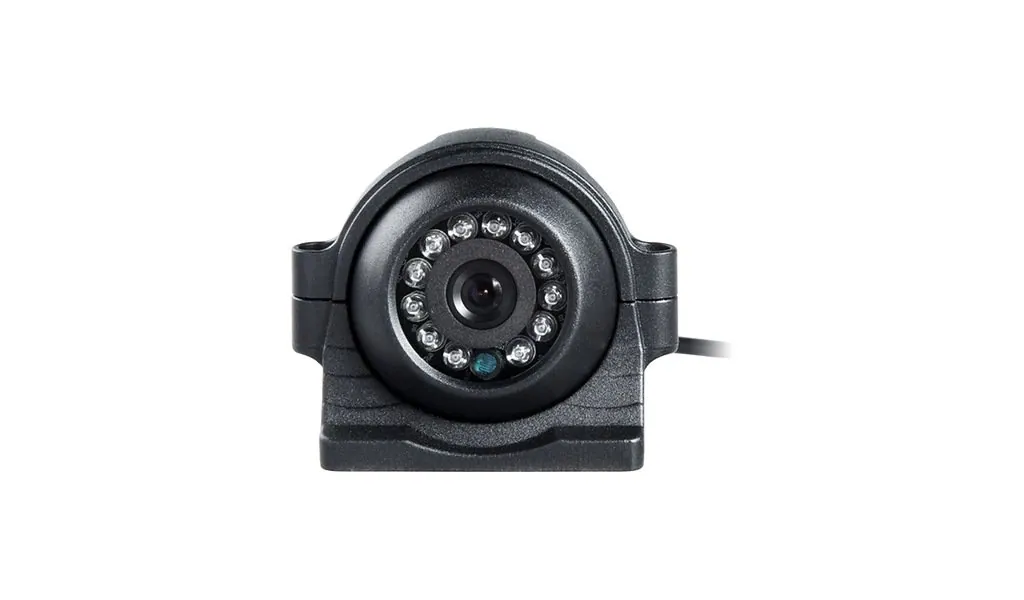
How infrared night vision works on vehicle cameras: lux ratings, 650 versus 850 nm LEDs, IR range, backscatter and why housing design decides image quality.
09 LED Flicker and Banding in Vehicle Video: Why Traffic Lights Strobe on Recordings
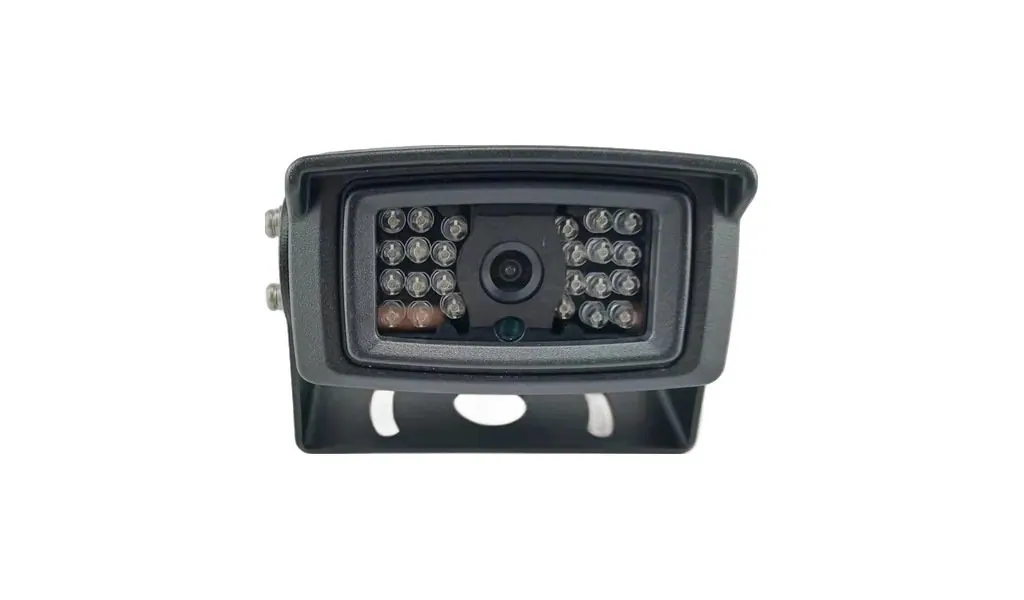
Why LED traffic lights and billboards strobe or band in vehicle video, why it matters for evidence, and what LED flicker mitigation changes.
Looking for a reliable camera system supplier?
Tell us your vehicle type and application — we will recommend the right system and quote within 24 hours. Distributors and OEM/ODM projects welcome.