
Thermal Cameras for Night Driving: Before the Headlights
At 80 km/h a truck covers 22 m every second. The useful question about a night-driving camera is therefore not how far it can see, but how many seconds it gives the driver. Headlights answer with reflected light; a thermal camera answers with emitted heat, and the gap between those two answers is the whole reason to fit one.

Key takeaways
- At 80 km/h every 22 m is one second; low beam gives about 2.3–3.6 seconds of warning.
- A 256×192 detector behind a 10 mm lens puts about 14 px on a person at 100 m and 5 px at 300 m.
- Detection needs roughly 2 px across a target and recognition about 8, so the same camera does both at different distances.
- Thermal fails for the hour after sunset, behind glass, in rain, and on anything at ambient temperature.
The number that matters at night is seconds

Distance figures are easy to quote and hard to use. Convert them to time at the speed the vehicle actually travels, and the comparison becomes obvious: at 80 km/h every 22 m is one second of warning.
On an unlit road, typical low beam puts usable light 50–80 m ahead — about 2.3 to 3.6 seconds at that speed. High beam roughly doubles the reach, but it cannot be left on with oncoming traffic, which is exactly when the risk is highest.
| Distance ahead | At 80 km/h | What it represents |
|---|---|---|
| 50 m | 2.3 s | Inside low-beam range on a dark road |
| 80 m | 3.6 s | Near the limit of usable low beam |
| 150 m | 6.8 s | High beam, with no oncoming traffic |
| 300 m | 13.5 s | A 256×192 thermal camera still has pixels on a person here |
| 400 m | 18.0 s | Detection only — not enough pixels to identify |
The claim worth testing is not that thermal sees further. It is that thermal keeps working when the headlights are dipped, when the oncoming driver is on high beam, and when the road ahead is unlit for the next kilometre.
What thermal sees that headlights cannot
A thermal camera images long-wave infrared emitted by the scene. It needs no illumination at all, so its range does not collapse when the headlights are dipped or when a vehicle comes the other way with its lights on high.
- Warm bodies against a cold background. A person, a deer or a stopped vehicle with a warm engine stands out against asphalt and vegetation.
- No glare. The sensor is not looking at visible light, so an oncoming high beam does not wash the picture out.
- Partial penetration of smoke and dust. Thermal is scattered less than visible light by airborne particles, though it is not immune to dense smoke.
- A stable image in total darkness. No IR illuminator, no visible glow, and nothing for a person ahead to notice.
That is why the thermal camera range is specified for night driving rather than for general surveillance. The advantage is not resolution; it is the seconds of warning on an unlit road.
Pixels on a person, at 100, 200 and 300 metres

A thermal camera does not see a person at a distance; it sees a few pixels. Take the JPC-256: a 256×192 detector behind a 10 mm lens with an 18° × 13° field of view. A 1.7 m person then occupies the following number of pixels.
| Distance | Person height in pixels | What it supports |
|---|---|---|
| 100 m | 14 px | Recognition — a person is clearly a person |
| 200 m | 7 px | Detection — something warm and upright is there |
| 300 m | 5 px | Detection at the limit of comfortable viewing |
| 400 m | 4 px | Detection only in good conditions |
Those numbers follow from the geometry: pixel height equals 1.7 m × 192 ÷ (2 × distance × tan 6.5°). The rule of thumb that goes with them is that detection needs about two pixels across the target and recognition about eight, which is why the same camera detects a person at several hundred metres but recognises them at roughly half that.
Where more recognition range is needed, the JPC-256Ai-AHD offers 384×288 and 640×512 detectors behind the same 10 mm lens, and adds pedestrian and vehicle recognition on the AHD output. A 640×512 detector puts about 2.5 times as many pixels on the same person.
Where thermal fails after sunset
Thermal is not a night-vision switch that makes everything visible. It fails in specific, predictable conditions, and a fleet that knows them will not be surprised by them.
- The hour after sunset. Road, vegetation and people cool towards the same temperature, and contrast collapses for 30–60 minutes before the scene separates again.
- Glass. Long-wave infrared does not pass through a windscreen, so a camera mounted inside the cab sees the glass, not the road. It has to be outside.
- Water on the lens. Rain, spray and a dirty lens reduce contrast far more than they do on a visible-light camera.
- Hot objects that are not hazards. Exhaust, brake drums, engine covers and recently parked vehicles all glow, and a detector without recognition logic will flag them.
- Reading. A thermal image cannot read a number plate, a sign or a colour. It is a detection sensor, not an identification sensor.
The hour after sunset is the one fleets underestimate. A camera that performs impressively at 22:00 can look almost blank at 18:30 in autumn, because everything on the road is still at the same temperature.
Mounting and aiming for night driving
A thermal camera is aimed at the horizon, not at the road surface. Too much sky wastes pixels on a uniform cold background and, in daylight, adds solar load to a sensor that is designed to look at modest temperature differences.
- Outside the cab, above the windscreen or on a front bar, clear of the wiper sweep and the washer jets.
- Horizon about one third from the top of the frame, so the road occupies two thirds and the far distance stays in view.
- A small hood or recess to keep direct sun off the lens and the housing, which matters more in summer than at night.
- A rigid bracket. Vibration that is tolerable on a visible camera blurs the small temperature differences a thermal image depends on.
- A display at eye line, not below the dash. A thermal image that requires the driver to look down costs more attention than it saves.
Field of view follows the job. The 10 mm lens (18° × 13°) is the night-driving choice because it puts pixels on the far road. The 3.6 mm lens (49° × 37°) and the 1.5 mm ultra-wide (120° × 86°) suit low-speed vehicles — forklifts, mining trucks, reversing — where the hazard is close and wide. Compare them in how far a camera actually sees.
The night test that settles it
A thermal demonstration in a lit yard proves very little. The test that matters happens on an unlit road, at night, with a person who is not holding a torch.
- Find an unlit straight road and mark 100 m, 200 m and 300 m from the vehicle.
- Put a person in dark clothing at 300 m and drive towards them at 40 km/h. Record the distance at which the observer first says they can see a person.
- Repeat at 200 m and 100 m, and write the three distances down rather than remembering them.
- Repeat with an oncoming vehicle on high beam. A visible camera will lose the person; the thermal image should not.
- Run the same test 30–60 minutes after sunset, when road and body temperatures are closest.
- Check the cab display at night brightness with the driver in their normal seat position, not standing beside the vehicle.
- Clean the lens and repeat once, because a film of road grime is the most common reason a thermal image looks worse than the demonstration did.
Frequently asked questions
Can a thermal camera see through fog?
Better than a visible camera, but not through it. Thermal radiation is scattered less by small airborne particles, so light fog and dust degrade the image more slowly than they do visible light. Dense fog still reduces contrast, and a water film on the lens hurts more than the fog itself.
Does a thermal camera work in rain?
It keeps working, but contrast drops. Rain cools surfaces, water on the lens scatters the image and spray from the vehicle ahead adds a moving veil. Thermal is at its best on a cold, clear night; in heavy rain it is a support to the headlights, not a replacement.
Can a thermal camera replace headlights?
No. It shows warm objects, not the road markings, signs, colours or unlit obstacles that are at ambient temperature. It is a second sense that works where headlights are weakest, not a substitute for them.
Is 256×192 enough for night driving?
For detection, yes: with a 10 mm lens it puts about 14 pixels on a person at 100 m and 5 at 300 m. If the fleet needs to recognise a person rather than detect one at 200 m, a 384×288 or 640×512 detector puts 1.5 to 2.5 times as many pixels on the same target.
Related articles

17. Thermal Imaging Cameras for Trucks: Detection Distances and Use Cases
How vehicle thermal cameras work, what 256×192 and 640 resolution mean on the road, how to calculate detection distance, and where thermal beats infrared.
Read guide 5 min read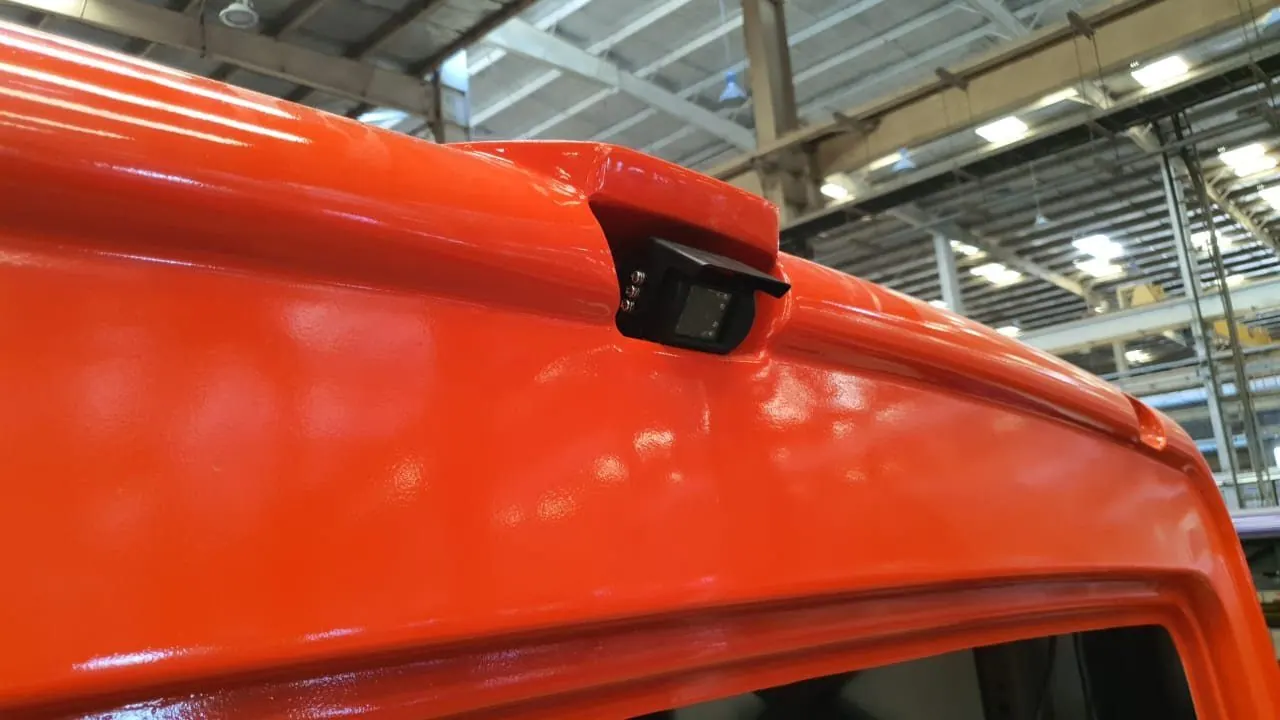
06. Night Vision for Commercial Vehicles: How to Read Lux and IR Specifications
How infrared night vision works on vehicle cameras: lux ratings, 650 versus 850 nm LEDs, IR range, backscatter and why housing design decides image quality.
Read guide 5 min read
02. How Far Will a Camera Actually See? Focal Length, Sensor Size and Field of View, Worked Out
Focal length, sensor size and field of view worked out: how far a camera sees, what lens reads a plate at 10 m, and the mounting blind strip.
Read guide 11 min readLooking for a reliable camera system supplier?
Tell us your vehicle type and application — we will recommend the right system and quote within 24 hours. Distributors and OEM/ODM projects welcome.