
DMS Cameras and Global Shutter: What the Sensor Does and Does Not Fix
When a driver-monitoring camera reports unreliable results, the recommendation is often to move to a global shutter sensor. The recommendation is frequently right. The explanation that comes with it usually is not — and knowing the difference is what tells you whether the change will work.
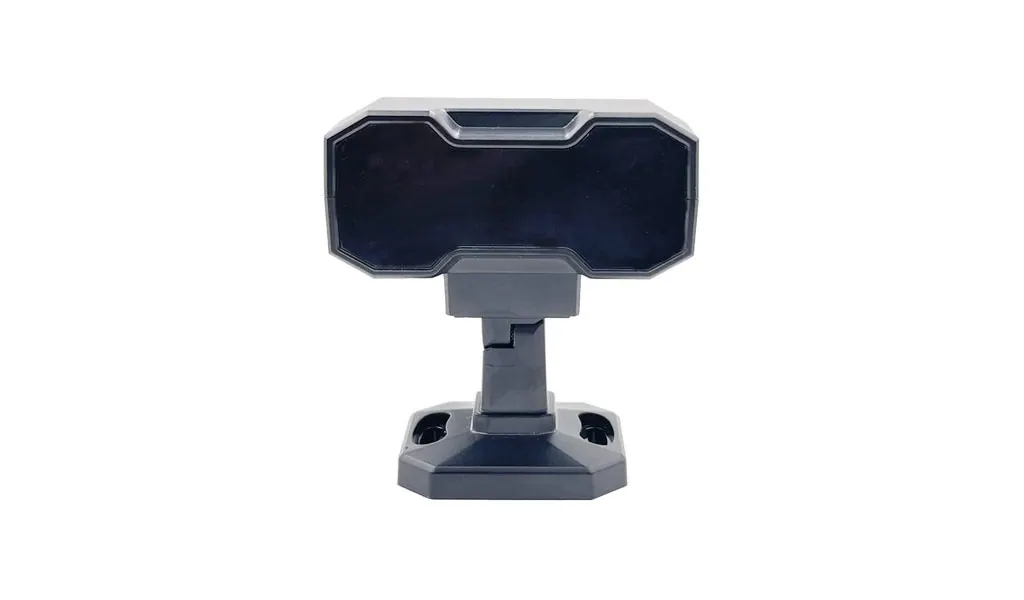
Key takeaways
- Clothing absorbing infrared and a face reflecting it are two different events.
- A global shutter fixes timing and geometry, not sensitivity — it does not create light.
- What it enables is a short, high-current infrared pulse that every pixel sees.
- Diagnose from the recording: banding means timing, a uniformly dark face means light budget.
This is a case we are asked about regularly, and it is worth working through properly because it involves three separate mechanisms that get compressed into one sentence. The situation: a driver-monitoring system works acceptably, one driver starts wearing a work vest, and the results become unreliable. The explanation offered is that the 940 nm illumination is being absorbed by the fabric, so not enough light returns from the face — and therefore the camera needs a global shutter sensor.
Start with what is true
Dark synthetic fabrics do absorb near-infrared. That part is straightforwardly correct, and 940 nm is absorbed more than 850 nm. So if the explanation stops at "the vest absorbs infrared", it is not wrong.
It is, however, answering a different question from the one that matters. Clothing absorbing infrared and a face reflecting infrared are two separate events. The illumination is aimed at the driver’s face. How much of it comes back depends on the emitter power, the lens aperture, the sensor’s quantum efficiency and the reflectance of skin — roughly 50–60% at 940 nm against about 65–70% at 850 nm. What the vest does to light that lands on the vest has very little influence on light that lands on a face.
How a vest can genuinely break the system
The vest does cause failures — just by a different route, and this is the mechanism worth testing for.
- Retroreflective strips. Safety vests are built to return light back along the path it came from. In the infrared that means strips can bounce a large amount of the camera’s own illumination straight back into the lens. Part of the frame blows out, the automatic exposure pulls the whole image down to compensate, and the driver’s face — which was marginal to begin with — goes dark. The vest is not absorbing light. It is telling the camera that the scene is much brighter than it is.
- The light budget was already tight. Skin reflectance at 940 nm is lower than at 850 nm, and interior materials absorb infrared. If the system was operating close to the detection threshold, a small change in scene reflectivity is enough to push frames below it. The vest is the trigger, not the cause.
Both of these are visible in the recording, and the two look different. That distinction is the whole diagnosis, so it is worth stating plainly: a blown-out patch with a dark face suggests the exposure strategy is being fooled. A uniformly dark, noisy face with no bright patch suggests the illumination is simply short of what the algorithm needs.
What a global shutter changes — and what it cannot
A global shutter exposes every pixel at the same instant. A rolling shutter, which is what most vehicle cameras use, exposes the frame row by row across roughly 30 ms at 30 fps. That is the entire difference, and it defines the boundary of what the change can achieve.
| Problem | Rolling shutter | Global shutter |
|---|---|---|
| Not enough light on the face | Unchanged | Unchanged — it adds no light and does not change quantum efficiency |
| The vest absorbs infrared | Unchanged | Unchanged — reflectance is a property of the scene, not the sensor |
| Horizontal banding from a pulsed IR emitter | Rows sample at different moments and catch different parts of the pulse | Every row samples in the same window — banding disappears |
| Fast head and eye movement | Row-by-row readout distorts moving detail | The frame is frozen geometrically |
| Low-light sensitivity | Better — no in-pixel storage node | Slightly worse — the storage node takes area from the photodiode |
So if the failure appears as a uniformly dark, noisy face with no striping, a sensor change on its own will not fix it — and it will make the light budget slightly harder, not easier. If the failure appears as horizontal bands or a strobing image, the shutter is the right lever.
The argument that does hold up: synchronised pulsed illumination
There is a version of the supplier’s case that is stronger than the one usually written down, and it is worth putting on the table because it is a genuine engineering reason to choose a global shutter for driver monitoring.
Because every pixel of a global-shutter sensor is live at the same moment, the infrared illuminator can be driven as a short, high-current pulse timed exactly to the exposure — a flash rather than a lamp. A short pulse can run well above the emitter’s continuous current rating, so the same device delivers considerably more optical energy into each frame than continuous drive would allow. A rolling shutter cannot use that trick: its rows are exposed at different times across the frame period, so a short pulse would illuminate only part of the image, producing exactly the banding described above.
Two caveats matter here. Eye-safety limits constrain peak power, and thermal limits constrain how often a pulse can be repeated — so this is a designed system, not a free upgrade. And it only applies if the illuminator and its driver are actually built for pulse operation. That is a question for the supplier, and it is a much better question than "should we change the sensor".
The second reason driver monitoring wants a global shutter
Independent of what the driver is wearing, driver monitoring is the one vehicle camera application where motion fidelity of a nearby, fast-moving subject decides whether the system works. Head nods, eye blinks and glance changes are small, quick movements. A rolling shutter distorts them, and the algorithm is reading exactly that detail. This is why the automotive industry converged on global shutter sensors for DMS and OMS while keeping rolling shutter for forward-facing and surround-view cameras, where the scene is further away and dynamic range matters more.
Diagnose before changing hardware
| What the recording shows | Most likely cause | What to change |
|---|---|---|
| Horizontal bands, or the illuminated area strobing between frames | Pulsed emitter not synchronised with a rolling shutter | Global shutter, plus emitter-to-frame synchronisation |
| Bright patch on the vest with a dark face | Retroreflective strips misleading the automatic exposure | Weight exposure metering to the face region instead of the whole frame |
| Uniformly dark, noisy face with no banding | Illumination short of what the algorithm needs | Emitter power, pulse capability, aperture, or 850 nm instead of 940 nm |
| Face correctly exposed but tracking drops in and out | Algorithm threshold or frame rate, not the optical front end | Check frame rate, exposure stability and detection settings before replacing hardware |
| Works on most drivers, fails on one | A scene-dependent effect, not a camera fault | Reproduce with that driver and vest, and compare recordings side by side |
Questions that get you a real answer
- Is the 940 nm illuminator continuous or pulsed? If it is pulsed, ask for peak current, duty cycle and pulse width.
- Is the emitter synchronised to the sensor frame? A synchronised pulse is worth more than a brighter continuous one.
- How does a global shutter solve light being absorbed? If the answer is about synchronisation rather than sensitivity, you have found the real reason — and it is a good one.
- What is the exposure metering strategy? Region-weighted metering around the driver’s face is a firmware question, not a hardware one, and it is the cheapest fix for retroreflective clothing.
- Has the failure been reproduced on a bench? With the same vest, the same distance and the same illuminator, the two failure modes look completely different.
Run the comparison, do not argue about it
The decisive test takes an afternoon: same vehicle, same driver, same vest, same position, and two cameras — the existing one and the proposed one — fed by the same illuminator. Record both, then compare three numbers:
- Banding. Count the frames containing horizontal stripes that cross the face region.
- Face luminance. Measure the mean brightness of the face region in each recording, not the whole frame, which is dominated by the vest.
- Tracking continuity. How often does the algorithm lose the eyes, in a fixed period, under identical conditions?
A recommendation that survives those three measurements is worth acting on. A recommendation defended only by a theory about absorbed light is worth testing before you commit a fleet to it.
For how driver monitoring fits alongside forward-facing assistance, see DMS and ADAS explained.
Frequently asked questions
Does a global shutter make a DMS camera more sensitive?
No, slightly less. It adds storage inside each pixel used to hold charge, and that storage takes area away from the light-sensitive part. Global shutter improves geometry and timing, not incoming light. Its value in driver monitoring is that it can be synchronised with a short, high-current pulse of infrared, which delivers more usable energy per frame than continuous illumination.
Why does my driver monitoring fail only for certain drivers?
Because the failure is scene-dependent. Retroreflective strips on a work vest reflect the camera’s own infrared straight back and mislead the automatic exposure, so the face is under-exposed. The same system performs normally on a driver in dark cotton and fails on a driver in a reflective vest. Region-weighted exposure metering around the face is the cheapest fix.
Is 850 nm better than 940 nm for driver monitoring?
850 nm reflects off skin more efficiently, roughly 65–70% against 50–60%, so the same emitter delivers more signal. It also produces a faint visible red glow, which some users notice. 940 nm is invisible and therefore preferred in premium cabins, at the cost of needing more emitter power. The choice is a trade between discretion and light budget.
Will a global shutter camera stop the banding on my recordings?
It will, provided the illuminator is synchronised to the frame. Global shutter removes the row-by-row sampling that causes banding, but if the emitter pulse is random with respect to the exposure window, all pixels can still be exposed during a dark part of the pulse. Synchronisation is the other half of the fix.
Related articles
DMS and ADAS Explained: Fleet Safety Monitoring That Works
What driver monitoring (DMS) and advanced driver assistance (ADAS) actually detect, how they differ from BSD, and how to deploy them so the data gets used.
Night Vision for Commercial Vehicles: How to Read Lux and IR Specifications
How infrared night vision works on vehicle cameras: lux ratings, 650 versus 850 nm LEDs, IR range, backscatter and why housing design decides image quality.
LED Flicker and Banding in Vehicle Video: Why Traffic Lights Strobe on Recordings
Why LED traffic lights and billboards strobe or band in vehicle video, why it matters for evidence, and what LED flicker mitigation changes.
Looking for a reliable camera system supplier?
Tell us your vehicle type and application — we will recommend the right system and quote within 24 hours. Distributors and OEM/ODM projects welcome.